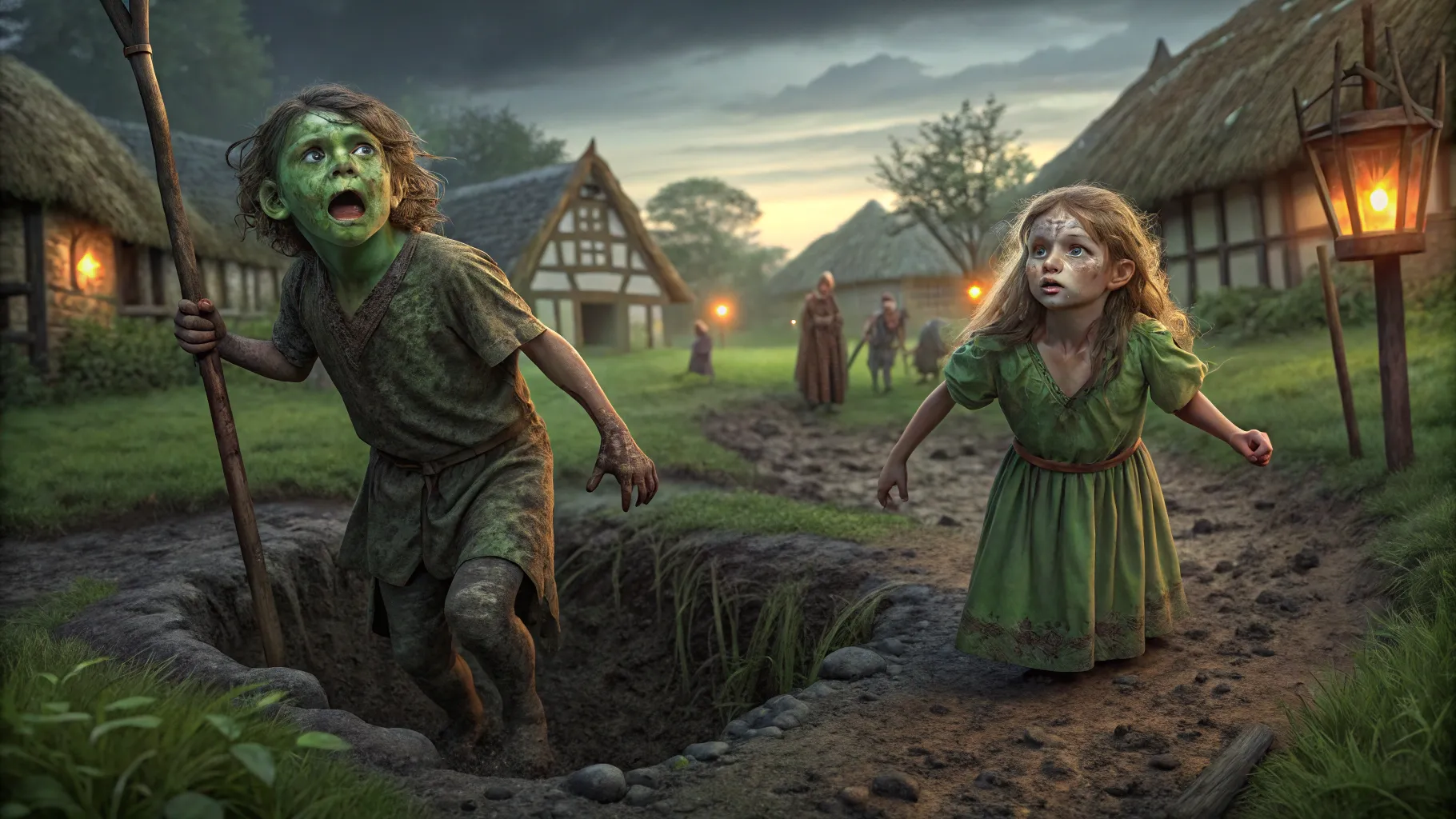
Inspired by a tale told on the Weird History channel, this is the story of two strange children who wandered out of a pit in 12th‑century England—children whose skin was said to be bright green. Their account is part folkloric fairy tale, part medieval mystery, and has puzzled historians, folklorists, and armchair detectives for centuries. Here’s everything we know (and don’t) about the green children of Woolpit, the sources that recorded them, and the most popular explanations for their verdant complexion.
The Strange Discovery
Sometime during the reign of King Stephen (1135–1154), villagers near Woolpit in Suffolk found two children emerging from a "wolf‑pit"—a trap dug for animals. The earliest surviving account comes from William of Newburgh, writing around 1189 in his Historia rerum Anglicarum. Another version, written later, is preserved by Ralph of Coggeshall. Both tell basically the same eerie facts: a boy and a girl, clothed in unfamiliar garments and described as having green‑tinted skin, appeared bewildered and unable to speak the local language.
Local reapers apprehended them and brought them into the village. They were taken in by a man often named Richard (variously recorded as Richard de Calne or Richard de Caux in later retellings), who provided shelter and care. The children were wary of most food offered to them, accepting only raw beans at first—a detail that becomes important in several later interpretations.
What the Children Said About Their Homeland
They came from "St. Martin's Land," a Christian country where everything and everyone was green, the sun never shone, and the world was wrapped in a perpetual twilight.
As the girl learned English, she reportedly described a homeland called St. Martin’s Land (or Saint Martin’s Land) where everything was green, the light was dim, and the people were of her same color. She claimed that she and her brother had been tending their flock and were drawn by the sound of bells. The sound seemingly led them into a tunnel or underground cavern, and they found themselves suddenly in the fields outside Woolpit—blinded and overwhelmed by sunlight.
The girl also mentioned a great river in her homeland, across which you could see a bright land—details that prompted William and Ralph to suppose the children's home might be somewhere in or beyond the region around Woolpit.
The Theories: Fairies, Aliens, Disease, or Misplaced Immigrants?
Over the centuries, every available explanation has been offered. Here are the most common theories and what they get right (and wrong):
- Fairy lore: In the medieval imagination fairies were supernatural beings who sometimes abducted or trapped humans in otherworldly realms. The children’s account of a dim, otherworldly homeland reached by a tunnel fits fairy narratives neatly, and 12th‑century villagers readily interpreted the event in supernatural terms.
- Aliens or interdimensional travelers: From a modern, speculative angle, some commentators (including later authors) have suggested the children came from another planet or dimension where light and skin tones differ. These explanations are imaginative but rest on no contemporary evidence.
- Arsenic poisoning: A folk explanation ties the tale to stories like "Babes in the Wood" and suggests poisoning (arsenic) could produce a greenish hue. In reality, arsenic typically darkens or discolors the skin rather than producing a true green pigment, so this is unlikely.
- Chlorosis or nutritional deficiency: Medieval accounts and later commentators have pointed to "green sickness" (historically called chlorosis), an iron‑deficiency anemia that some believed gave sufferers a sallow or slightly greenish complexion. The children's initial refusal of most food and their acceptance of raw beans has been read as evidence of malnutrition—possibly producing an odd skin tone that faded once their diet improved.
- Immigrant children and language confusion: The 12th century saw significant Flemish immigration to eastern England. Some scholars propose the children were simply Flemish or from another region and spoke a dialect unfamiliar to Woolpit villagers. If they were lost or orphaned immigrants—perhaps displaced by conflicts—this could explain both their language barrier and their appearance as outsiders.
Why the diet detail matters
The sources stress the children only ate certain foods at first—especially green beans (or bean stalks). Beans would have been familiar in some rural diets, and beans are green; the detail has been used to suggest a symbolic explanation (their green diet reinforced their green skin) or a medical one (a restricted diet producing anemia or other discoloration). The surviving chronicles say the girl's green tint faded as her diet improved.
Conflicting Accounts and the Children’s Fate
William of Newburgh and Ralph of Coggeshall differ on a few points. Both agree the girl grew up, but they disagree about the boy. In William’s version the boy dies shortly after baptism; in Ralph’s account the boy is melancholic and dies before baptism. Both writers assert the girl survived into adulthood. Ralph, with a moralizing tone, claims she later lived "loose and wanton," while William merely notes she married and lived.
Modern researchers have dug into local records for traces of the girl's later life. Scholar Duncan Lunan suggested a possible identification of the girl as "Agnes," who may have married a Richard Barre and appeared in a 1197 petition involving land—though this link is speculative. Other researchers caution there is no firm proof connecting the petition to the Woolpit story.
Problems with the Evidence
Several issues make the case frustratingly fuzzy:
- The first accounts were written decades after the event and are not eye‑witness testimony—William and Ralph likely relied on local oral tradition.
- The Anglo‑Saxon Chronicle, a contemporary record of many odd events, does not mention the green children, which raises chronological and reliability questions.
- Place names and spellings vary in later retellings, and medieval record‑keeping was inconsistent, making genealogical links uncertain.
Conclusion: A Medieval Mystery That Keeps Growing Greener
The green children of Woolpit sit comfortably between legend and history. The contemporary chronicles preserve a striking, strange story: two green‑tinged children, an underground tunnel, a land called St. Martin’s, and a cast of bewildered medieval villagers. Whether the root cause was folklore, medical condition, displacement, or something we can’t yet imagine, the tale endures because it resists tidy explanation.
What do you think happened to the green children? Were they fairy folk, hungry immigrants, victims of illness, or something else entirely? The mystery is as verdant as ever—post your theory and let’s keep the conversation growing.